

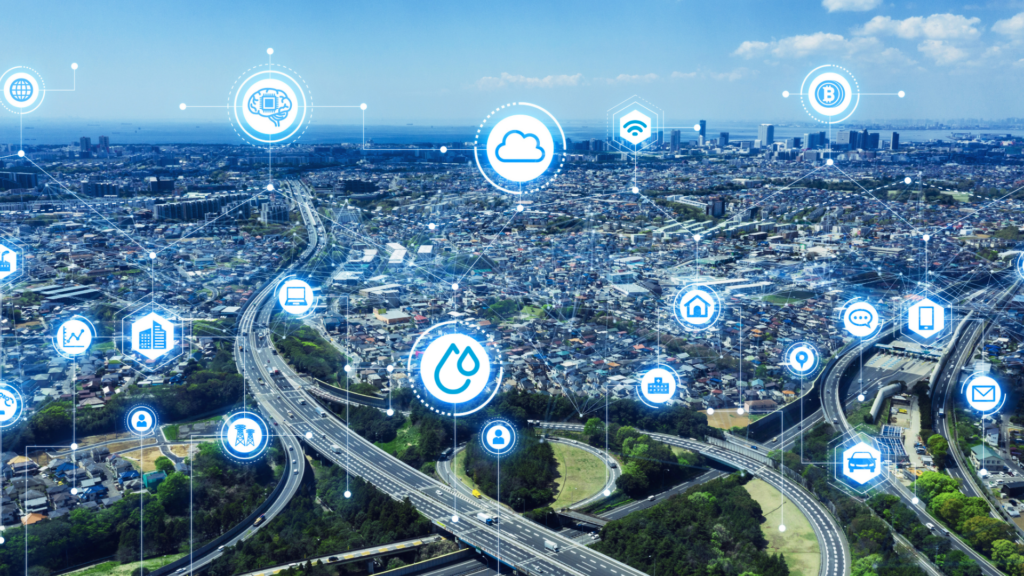
Whether it’s reducing emissions, optimizing resources, or generally improving liveability, smart cities are giving everything from road networks to power grids a digital ‘up do’.
But as climate risks intensify, the issue most in need of enhanced resilience is society’s continued reliable access to water. Recent data from CDP reveals that 83% of cities reporting environmental data face serious climate hazards, with water infrastructure among the most exposed.
To adapt, cities need deep insights into their vulnerabilities as well as actionable strategies for resilience. This is where AI technology is a transformative force.
Why AI Matters for Climate Resilience
In threatening city water supplies, climate change also amplifies societal inequalities and challenges business continuity creating a vicious cycle. AI provides unprecedented capabilities to understand these risks and mitigate against them.
AI rapidly processes and visualizes vast datasets, delivering actionable intelligence to aid effective action, forecast hazards, and rapidly identify preventive measures. Generative AI can even help envision outcomes and provide timely task-based guidance for all skill levels.
Nowhere is this more valuable than the water sector, which is too often left alone to hold the frontline against water scarcity with little uplift in available resource levels.
FIDO AI: Real-world Water Data in Action
FIDO AI is an example of AI which is being applied to improve water network and resource efficiency – in this case tackling society’s water loss problem.
Around 30% of the world’s water is currently lost from public utility networks due to leaks and theft. It dwarfs the amount being used by data centres, meaning that FIDO AI, far from being a drain on public resources, actually improves local water availability.
It does this by analyzing millions of verified global acoustic pipeline data points to identify stress in clean water distribution systems allowing utilities to act decisively.
In one example, FIDO helped a South Asian utility uncover severe damage to a recently-constructed strategic city water pipe that had been rendered unusable due to leakage. The insight provided by FIDO AI – the exact location of the leak – validated the city’s earlier investment and instantly improved its resilience.
Accessible Technology for All
Which brings me to another benefit of AI – its potential to democratise access to data and accelerate action on climate risks due to innovative delivery, feature and financing models.
These include SaaS subscription models which leverage the capabilities of cloud-based AI to lower the cost and increase the versatility of enabler hardware like sensors. This could replace the need for multiple traditional pieces of equipment vastly reducing the investment needed to equip a team.
Generative AI also opens the potential for delivering guided tasks at lower skills levels, freeing up experts for higher value work. By using a semantic layer to translate complex datasets into next-best-action prompts, GenAI allows users to interrogate vast information ecosystems and receive clear, actionable guidance in natural language.
On innovative financing, the work carried out in South Asia was funded by a third-party corporation. FIDO’s corporate water stewardship program Aqua Plus pioneered a model (since much copied) which encourages businesses to support the accelerated adoption of advanced technologies on public networks. In return, they get validated water savings they can report towards their sustainability or risk goals.
Engaging Citizens in Water Resilience
Beyond utilities and corporations, AI also opens doors for citizen engagement. FIDO recently won a global prize to co-create a STEM education project with a major technology partner based around our AI-led hardware.
But why should ambition stop there? AI-enabled apps lend themselves perfectly to the gamification of education and tasks, informing and nudging consumers to make better decisions with personal and community rewards. A crowd approach to better water network resilience, fostering community involvement and awareness, if you like..
Turning water management into an interactive experience could help cities build trust, reduce losses, and strengthen resilience collectively.
The Future of Smart Water Management
This collective action is important because no single organisation, even a water utility, can tackle the problem of water stress on its own. Water resilience is the bedrock of a smart city – a shared problem and the foundation of a sustainable economic infrastructure on which smart cities can be built.
Consumers know this. One in five people fear their city is underprepared to manage climate-related risks and many believe the private sector is not doing enough to support climate adaptation.
I believe that AI-driven solutions like FIDO AI can be catalysts for accelerated digital transformation and collaboration.
By combining accurate data, intuitive design, and inclusive engagement, AI empowers smart cities to safeguard water resources, reduce emissions, and create a resilient future for businesses and communities alike.
Start your journey toward smarter water management.
FIDO AI empowers utilities and city planners with actionable insights to reduce water loss, optimize maintenance, and engage communities in resilience efforts.
